Samstag, 8. Februar 2014

Translator's Rant


So I'm very busy these days. Mainly because I was hired as a translator for http://weiqitv.com/.


actual screenshot I took three minutes ago and then edited in MS Paint for three minutes
It's a great website with an astonishing variety of videos, suitable for beginners to 7d players (I reckon that even pros watch them). It's run by (relatively young and) active pros who are up-to-date about the latest Go fashions.

As you can see, everything is in Chinese. And I happen to speak Chinese. But I'm sure most of you don't.

That's why they asked me and a few others to translate a few videos to English, for the English WeiqiTV due to launch in March! It won't be completely free, but I think 0.74€ (1$ as of today) is reasonable for a video or a set of videos. And please check the free sample videos:) (in March).

By the way, WeiqiTV is looking for apt translators! Should be fluent in Chinese and written English and around Dan-level in Go.

But you know, Chinese and English aren't in the same family of languages. (A part of my university studies is linguistics, so I should kind of know what I'm writing about.) Like not even similar.

But according to the guy whose name I forgot, everything that can be expressed can be expressed in any language. I found that this does not always apply to translations of Go videos.
There is another dude (or was it two dudes? I don't remember:p) who said that the way you think is determined by your language. People who grow up with different languages think in different concepts. I do come across this sometimes in those videos.
Anyways, those are the two extreme positions on this issue. I think the truth is surely, as almost always (aah, an alliteration), somewhere in the middle. (Well, except darwinism vs. creationism.) And I'm sure someone has already thought of this and given it a scientific name. I hope my university teachers won't come across this blog.

So, when I translate from Chinese to English, most of the time it goes smoothly (according to the first dude's theory). But I come across several issues from time to time. Sure, there is always a way to paraphrase something, but there are aspects that cannot be translated accurately. Partly because I see to it that the English sentences are about as long as what they say in the videos. If I translate a Chinese phrase of 4 syllables to 3 English sentences, the subtitles won't be able to keep up with the speech.
Therefore, to a certain extent, a translation also includes an interpretation by the me, the translator. Which is why a certain knowledge in Go is required so that the interpretation of the translator doesn't differ too much from view of the dude talking in the video.

Firstly, the Go moves should be named correctly, which is not always as obvious as you might think.
Then what does the commentator think about these moves? Four-syllabic idioms happen to be a common way to express ideas with a poetic touch. Translating those sometimes sounds extremely stupid or over the top. But I usually find my way around them.

I planned to rant some more about Chinese grammar, but I realised that it might not be interesting to read, and I don't know it so well. (This is a common occurrence among native speakers in any language; if you want some grammar explained, from my experience it's usually safer to ask someone who's been learning that language. I think I speak Chinese like a 7-years-old kid who is abnormally versed in Go jargon.)

I shall rant about Go jargon instead.
First of all, let's take a moment to appreciate the geography of a Go board.


This tengen-centric view of the Go board defines various word for the move in the following diagram, in relation to the circumstances.


I will use this move to complain about the lack of English Go vocabulary. 
(Please note that my knowledge of English Go terms comes from KGS kibitz and Go books, no scientific background whatsoever. Also I'm sure this list is not complete.)


The word extend/extension is one of the most ambiguous translations of Chinese Go terms. (Also Japanese and, probably, Korean, but I know Chinese the best, so...:p) As a result, certain concepts of Go are not available for anglophone Go players (see second theory I mentioned).


So here are some moves that, dieu merci, have different names in English:
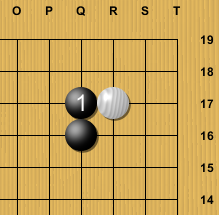

 Block, 檔
Push (see below)
Bump

Iron pillar 鐵釘
Etc. etc. etc.

Chances are you mistakenly call some of these "extend" or "nobi" anyway. According to Ferdinand de Saussure (I know his name because he was mentioned in like 8 of my classes), a sign, i.e. in our case the names we give Go moves, is composed of a signifiant and a signifié (yes, he was French). 
The signifié is the concept of a move in your brain, which is inextricably connected to its signifiant, which is what happens when we talk about that move. 
Therefore I think if you don't call the moves correctly, you are missing concepts and ideas. Thus learning what the moves mean would also make you a better player.

One very important distinction would be sagari and nobi.


Descend 立 =going DOWN
EXTEND!!! 長 =advancing AHEAD (regardless of geographical direction)
De Saussure also said that signs get their value only by opposition to other signs in the system. If you have only one name for so many moves, that name has no meaning.

Above I cited examples that can be translated fairly accurately.

But what do you call the following moves?


退
I call this move "drawing back" in the subtitles. This is definitely not a nobi.


"Escape the stone", however "extend" is also valid.
 No idea how to translate this move (narabi), but I REFUSE to call it nobi.


And who the flick first called this an "extension"?

 While making this post I realised that there are different kinds of "push" too.


爬 literally "crawl"
壓 to press
 衝 to dash, you know, Rambo-style

So far so good. This might not have blown your mind, but the whole point is to not call everything "nobi". (Not to mention the different kinds of "attachments" 碰, 靠, 托...)

I'll introduce you to two more Go concepts that don't enjoy literal translations in English.

1) 軟頭/硬頭 "Soft head/hard head":


This is the most commonly "soft head". White's further advancement will be hindered by the weakness imminent in this shape. This term also applies to positions other than on the edge:


White's head is totally soft. Black has many moves to choose from, should a fight go towards this corner. As opposed to a "hard head":


This is like the complete opposite of a soft head. Coincidentally, the last move in this position is called "phallus nobi".

2) 損

I always have a hard time translating 損 (or 虧). Literally it means "loss". However it can be applied to almost anything in Go. You can 損 points, an exchange (as in furikawuri ~trade) can turn out 損, you can make a 損 exchange ("a bad exchange"), you can 損 liberties, aji, ko-threats, etc........ Also 損 is used as verb, noun, adjective... as many Chinese words are.
 
I'm too lazy to complete this post right now:( Uaaaaaaaaaaaaaaaaaaaaaaaavhghfbwdbclkj

Dienstag, 27. August 2013

Long Time

Hello!

I haven't posted anything for a long time. What have I been doing?

-Now I have three kinda inactive blogs. :S

-I contributed the background music for the PORG recruting video 2012. (There will be a second video one day displaying the graphic progress that the project has gone through since then.)

-Schayan beat me in Austrian champignonship finals, so I'm Austrian vice champignon 2012! (I was champignon 2008-2010.)

-However, my team in German internet league (Deutsche Bundesliga), Berliner Zebrapinguine, legendarily won the tournament!

-I just received an A (einen 1er) for my Proseminararbeit (in German) about "Go in movies". :D

Bild auf dem Deckblatt

-Currently working on a list of Go vocabulary so people can read 围棋天地 Weíqí Tiāndì, a Chinese Go magazine.

-I became junior admin on KGS. So kids, behave!

-Unexpectedly, I played better than usual at EGC 2013, so I'm European 6d now!
Thus I shall raise my price for the rumoured Sandmann reviews: From now on, the price for one offline review will correlate with my EGD rating. E.g. at the time I'm writing this my rating is 2576.717, so one commentary of your game will cost 2.58€ (previously only 2.50€).

-Blogspot became much easier to use than last time:)

Cheers, Viktor

Donnerstag, 30. August 2012

Pros' Nicknames According to Chinese Poker Cards

translated by the me
to be completed when I overcome the laziness

♠A 聂卫平 Nie Weiping "Go Saint"
♠K 藤沢秀行 Fujisawa Hideyuki "World's Number One of First Fifty Moves"
♠Q 大竹英雄 Otake Hideo "Cosmetic Player"
♠J  林海峰 Rin Kaiho 二枚腰 (google says "Two Waists")
♠10常昊 Chang Hao "Duck"
♠9 高川格 Takagawa Kaku "Fox"
♠8 依田紀基Yoda Norimoto "Tiger"
♠7 朴永训 Park Yeonghun "Half Point Prince"
♠6 周鹤洋 Zhou Heyang 濟公 (not sure what it means, can range from "Facilitated Duke" to "Economic Husband")
♠5
♠4 谢赫 Xie He "Xie Saint"
♠3
♠2

♥A 古力 Gu Li "Ancient Great Force" (Gu Li means ancient force)
♥K 曹薰鉉 Cho Hunhyun "Gentle Wind Fast Gun"
♥Q 孔杰 Kong Jie "Little Beauty"
♥J Yu Ch'ang-hyeok "World's Number One Attacker"
♥10加藤正夫 Kato Masao "Stone Amputator"
♥9 陈祖德 Chen Zhude "Chinese Fuseki"
♥8 崔哲澣 Choi Cheolhan "Venomous Snake"
♥7
♥6 刘小光 Liu Xiaoguang 天煞星 (google suggests "Day fiends" but I think it means more like "Nemesis". I've also seen Kato Masao being refered to by the same nickname.)
♥5 芮乃伟 Rui Naiwei "Witch That Paints the Board"
♥4 王立誠 O Rissei "Assassin"
♥3 Cao Dayuan "Little Zhuge" (Zhuge Liang, one of the greatest strategists and scholars in Chinese history, his uncommonly two-charactered family name is synonymous with intelligence and strategy)
♥2 胡耀宇 Hu Yaoyu "China Hero"

♦A 坂田栄男 Sakata Eio "Razor"
♦K 趙治勲 Cho Chikun "Digging Mole"
♦Q 小林光一 Kobayashi Koichi "Subway Style"
♦J  木谷実 Kitani Minoru 聖童丸 "Sacred Boy Dumpling"(??)
♦10俞斌 Yu Bin "Washing Mashine"
♦8 周俊勳 Zhou Junxun "Red-faced King"
♦7 石田芳夫 Ishida Yoshio "Computer" (Electronic Calculator)
♦6
♦5 王檄 Wang Xi "Rapid Cannon"
♦4
♦3
♦2 邱峻 Qiu Jun 磨王 "King of Polishing" (in the sense of being diligent, I'd guess. It's a pun on 魔王, demon king, which sounds the same in Chinese)

♣A 李世石 Lee Sedol "Little Lee Flying Knife" (or perhaps Shuriken)
♣K 武宮正樹 Takemiya Masaki "Cosmic Style"
♣Q 马晓春 Ma Xiaochun "Demonic Sword"
♣J  張栩 Cho U 韋陀天 (google suggests "Veda days", literal translation would be "Heaven of steep banks made of leather")
♣10罗洗河 Luo Xihe "Divine Pig"
♣9 小林覚 Kobayashi Satoru 本格派棋士(I don't know what it means, google suggests "The Grid represented in terms of financial", however "Basicist School Player" would make sense, as a friend suggested)
♣8 刘星 Liu Xing "Beauty Guy" (althogh Liu Xing means "Killing Star":D)
♣7
♣6 橋本宇太郎 Hashimoto Utaro "Tensai (=Genius) Utaro"
♣5
♣4
♣3
♣2 井山 裕太 Iyama Yuta "Golden Boy"

Joker 李昌鎬  Lee Changho "Stone Buddha"
Joker 吳清源 Go Seigen "Saint of Shōwa" (Shōwa period 1926-1989)
Extra Card: 54 Go masters, sorted by their playing styles. Blabla disclaimer

Samstag, 31. Dezember 2011

An Interview with Schayan Hamrah, Austrian Champion 2011

from http://eurogotv.com/

The Austrian championship finals, a class A tournament, took place in mid December and I proudly present to you an interview with the winner, Schayan Hamrah, conducted and translated by the sandmann!

http://goverband.at/bilder/statemaster2011.JPGsandmann: So, how does it feel to be the Austrian champion?

Schayan: It’s somewhat cool to be the Austrian champion (the youngest of all times:D). It’s a pity though that the previous champion didn’t make it to the finals, I’d rather have seized the title from him than winning it in this manner.

Schayan is the youngest champion in Austrian Go history at 16 years and 3 months, beating the previous record by 8 months. Coincidentally, Schayan is also the current Austrian youth champion.

s: How did the finals go?

SH: It was exhausting and enthralling! After I lost the first game from a favourable position by 1.5 I didn't imagine that I could pull myself together and win the remaining games since I had yet to face the toughest (imho) opponents, but with a good bit of luck and endurance I somehow did it after all.

s: Which was the hardest game?

SH: The one against Lothar Spiegel 4 dan. I ended up viktorious after 4 and a half hours, by 3.5 points.

s: I watched the live relay on KGS. I saw there were many close games.

SH: Indeed! This shows that the best players in Austria are very close in strength.

s: Did you prepare for the finals?

SH: I replayed a few Korean games every day to boost my fighting spirit. Sometimes I had too much of it in my games though.

s: Do you play on the internet?

SH: I do, but I rather play in real life (preferably with shell and slate stones in the Go club which are actually not free to use).

s: How is the Go situation in Austria?

SH: The game is not as widespread as in e. g. France or Germany or the Czech Republic. As a result there are fewer strong players. The Austrian champion is only 3 dan compared to the 6 dans of the above mentioned countries. We need to work on this still.

s: Are your friends more interested in Go than before you won this prestigious title?

SH: Nay, they're more into partying than mind sports.

s: Do you want to say anything else?

SH: Nah.

s: Thank you!


Happy New Year everyone!

Dienstag, 3. Mai 2011

Völkerkundemuseum

Bei der Benefizveranstaltung für Japan im Völkerkundemuseum musste Go natürlich auch präsentiert werden.


Da war auch dieses aufgeweckte japanische Kind. Wir dachten schon fast, es wollte unserem Zoltan im Fuseki Vorgabe geben, leider hat er eine Leiter verlesen und konnte danach nicht mehr aufholen. (Es hat im Museum übrigens Geld verloren, wir wissen nicht genau, wie viel, entweder 6 Euro 30, 36 Euro oder 630 Euro. Ehrlicher Finder bitte melden.)

Samstag, 30. April 2011

Tournoi de Paris and whatever else happened

Let's start with the conclusion from my tournament games:
I am improving at getting lucky and making my opponent mess up. And I started talking English with French accent.

Otherwise there is not much to say. Three Chinese pros participated at the tournament (including MilanMilan and smartrobot, I don't know the third one but I think he resembles Lee Changho a bit). The tournament was held in Antony, in the outskirts of Paris. Rumors have that next year it will actually take place IN PARIS!

sad news: La Maison du Go ("Hugo c'est qui?!"*) had to close a few days after the tournament due to bankruptcy.

random facts: if you get caught fare-dodging (not buying tickets in the Metro) in Paris, you should tell them you are a foreigner (or pretend that you only speak Chinese) because they pay only the half of the penalty (25€ instead of 50€). ;)

There is a Book-Off in Paris! When you go to the Metro station of the Aligré club Troll Café, which is called Ledru Rollin, get out at the wrong exit and you will find it. They stock e.g. Manga for 2€ each.


*the joke is that La Maison du Go sounds the same as La Maison d'Hugo. In French when a word starts with a vowel or an h (which is not read, so pronounciation-wise it still starts with a vowel), the last sounding consonant of the preciding word is linked to the word's pronounciation. Take a guess how the first RER train station after Paris CDG airport "Parc des expositions" is pronounced.


Nichtgospielervernichtung am Ottakring

Da waren Schulklassen. Da waren Stände mit Go, Schach, Boxen, Essen, ein Kasperltheater und ein kaputter Wuzler. Dann waren die Schulklassen weg. Ich spielte Schach. Was war das überhaupt für eine Veranstaltung?:) Ist ja auch egal, Hauptsache, die Schulklassen wissen jetzt, was Go ist.


Freitag, 18. März 2011

Blubblablaaahablubb

The European Youth Championship took place in Brno last weekend. Just in case you are wondering, I did very badly, losing games I could have as well won, if I wasn't as weak as I am, and not winning games that I could not have won.

Btw, the EYGC 2012 has no host yet. This is a good opportunity if you feel like
supporting European youth!


Just two days after the tournament, Czech Republic faced Germany in the Pandanet European Team Go Championship. Since I missed the last train hanging around in a tea house (which was totally worth it, see below), I considered staying one more night to help the local commentator comment the games (who got sick in the end and couldn't come). Thus it was decided that I stay one more night to help him comment the games.

This brings me to the topic I have been pondering about ever since.

Instead of commenting just the first board (which seemed like a pretty one-sided game), I switched between the four boards to check the situation and explain a bit what had happened. The second board was a fighting game which involved a lot of reading, exchanges and finally also dead groups.
Third board was pretty one-sided as well, but in the end the unfavoured party managed to cheat spectacularly, spotting a mental weakness of his opponent who was probably like come on, resign already (which I would have been thinking too).
On the fouth board the local Brno hero played in the Czech team, he was particularly stressed about the game. After some kind of investive fuseki where he gave his opponent many points, Germany started to get too hooked on a ko and finally had to spend 4 moves there. In the meanwhile, Czech dude had mapped out his own piece of territory and cut off a group. Unfortunately he didn't manage to attack the group in a cool manner and was behind after the fight. This resulted in the first loss of Czech Republic.
Luckily for that guy, it remained the only loss. One by one, result windows popped up saying that one of the players had resigned or so, and finally we could confirm the result of Czech Republic beating Germany 3:1!

just imagine me standing there, holding the wine glass and blathering

This was exactly the way I commented the games. I didn't get much into detail, but explained the games in a way that the audience could follow who was ahead and stuff like that. It was not quite educative, but probably easy to follow and we could kind of watch all games. My question of this week, what makes you a good game commentator? And subsequently, what makes you a good Go teacher?
For starters, I think that a good teacher doesn't need to be a good Go player. (Of course it would be preferable if he wasn't a bad one.) I've heard that someone who couldn't swim had produced medal winners (in swimming). Nevertheless, this doesn't work with e.g. English language teachers.
I think that Go is something inbetween which required skills of both directions.
Consequently, if a Go player is strong, he is not necessarily a good teacher.
I don't know yet what we can conclude from this.

And thus ended my weekend on Wednesday.


Places worth visiting (cont.)

Brno

Brno is a city where very cool people live and thus a cool place to hang around. I was particularly impressed by the tea houses. It seems that the Go players meet there regularly to play Go and drink tea. And to eat wasabi nuts, which I totally recommend, and smoke waterpipe. (And I won at Settlers of Catan while the last train home left without me:D)


Another reason to go to Brno is that the beer costs less than 1 € in clubs. (compare with 8€ in a Swiss club)


(I particularly liked the kids' disappointed gaze when it was pointed out to them by the opening ceremony dude that Brno and the South Moravian region were known for the wine, but unfortunately they were too underage for that.)

Cha no ma (Vienna)

The one thing the tea houses in Brno didn't have was Matcha. I cannot explain its taste, it's just delicious and Cha no ma (it roughly means house of tea) is a totally Japanese place to hang around.


Targu Mures/Romania

It seems a lot of cool people are going to Shusaku Cup next week.

http://www.shusaku.ro/ecupa2011.html

Linz

The tournament in Linz, which is one of the top 5 Austrian tournaments, will be held on 2-3 April. Linz is where I go to university and I have to admit that the people are nicer than in Vienna.
This time there will be a seperate 13x13 tournament for there are many beginners who don't trust 19x19 yet.
Don't hesitate to join even if you are one of them!

http://linz.goverband.at/


Japan

The recent catastrophy has made me think that humanity is doomed to extinguish itself one day. The industry just wants to get money so badly, it neglects dangerous stuff like this. Let's take genetically manipulated food as an example (or air pollution, it's not as if there hasn't been any technologic stuff invented to make emissions of factories less harmful, it's just that it costs). Food is adjusted on a genetic basis to make them more lucrative for the people who do that. Nobody knows what might happen to people in the future who eat that food. Or to their children. The best and hopefully most likely scenario is that nothing will happen. Though thinking of worse cases doesn't require a great amount of imagination.
However, the situation is already quite *beep*ed up if the best thing that can happen is that nothing happens.

(Don't get brainwashed by me)

Samstag, 5. März 2011

ZzzzZZZZzzzzzzz...

I sincerly apologize for slacking off and not writing much in near past. I am really demotivated to do anything besides sleeping. I am not even motivated to go to university (I planned this term really awesomely and I am supposed to like the courses I have).
My KGS-mom told me that this is a symptom of sleeping too much. :O Now I am supposed to cut my sleeping time and do weird things as jogging and doing the laundry in the morning.
I've always seen sleeping as a kind of honte. Honte is a move that you just can't do without or without which you are extremely limited in your possibilities. A honte improves the further developement and although seemingly slow, it is worth spending the ressources of one move for it.
So too much honte is no good either. Or so it seems. I'll try getting up earlier tomorrow. But not jogging in the morning or anything alike:) Let's see if it helps.

Sonntag, 27. Februar 2011

Neuer Post

A lot has happened since I last posted...

-I realized that Tygem kibitz is worse then KGS. Imagine the content of your junk mail folder posted during a game and everybody (even 9d) trolling without admins. (All in Chinese.)

-Won Seong-Jin spectacularly defeats Lee Changho in the Fujitsu Cup:

Lee Changho resigned while he was winning. The game would be decided by a pretty huge semeai, when Won played the winning move: tenuki! (my favourite move btw) It mislead Lee into misreading the semeai and believing he would lose it when in fact he could have won if he had continued playing. Nice trick, huh?

See the game commented by An Younggil 8p: http://gogameguru.com/commentary-lee-changho-won-seongjin-fujitsu-cup/


-places you should visit:

Erding, 5-6 Feb 2011, was a great tournament as it has always been. Located in the South of Germany, it attracted 112 players for the main tournament (including 12 Austrians if my count is correct) and an unknown number of kids for the 13x13 tournament.

Do join those excited participants of Erding next year!


The Ishi Go Club organized a tournament in Lausanne 19-20 Feb. Even though there were not as many participants as Erding because the organizers were stupid and chose the same date as another huge tournament (last year too -__-), I played exciting games nevertheless.


Lausanne is a beautiful city in the left of Switzerland and definitely worth visiting even if there is no Go tournament!


Sonntag, 30. Januar 2011

KGS kibitz

Just when I should be studying for upcoming exams in foreseeable future, I have been mooching around on KGS and kibitzing.

I noticed that a shift in the habit of kibitzers has been taking place over the last few units of time. The random shoutings of "KO!" and "seki" have decreased. Now it is words like "semedori" and "aji" which make you sound smart.

Secondly the use of words coined by KGS such as "stong", "farl" and "qnert" seem to have declined.

And due to the influenza of MilanMilan, there are a handful KGS 9d who actually speak, contrary to the former situation.

*Kibitzing is the art of commenting an ongoing game. Common techniques involve talking about the players, ranks, Chuck Norris and your mom.

Get Strong at Kibitz!

Montag, 29. November 2010

How do I study Go?

I have been asked this question frequently. Here I shall explain to everybody how I study Go.


For that purpose, let me slightly modify the question. How Do I study Go?

A Japanese top pro player (if you know who it was, I'd appreciate it if you told me) once said that ordinary people cannot understand how he studies Go. When asked about details, he answered "I study Go by watching the trees blossom."

The thing is, nowadays I am sort of lazy to open the book and place stones on my awesome home-stuck Go board (in the picture below).


But don't take this as an excuse for not studying. I was very studious when I was still young and promising. In every spare moment, I would solve tesuji problems, replay pro games, study joseki, compete with my rivals and so forth. I was also blessed with the presence of Kobayashi Chizu 5p sensei who taught and spread Go in Vienna for one and a half years. It was also due to her ambition that a few Master Courses with top Japanese pros such as Takemiya Masaki 9p and Aoki Shinichi 9p had been organized.


Of course I also attended (and still attend) a lot of Go tournaments and met a lot of cool people.

This all helped me to improve and solidify my knowledge and feeling for Go.
I would still like to improve, but I am either too lazy or too busy or both nowadays.

Even though I do not study Go as frequently as before, I have found a lot of similarities between Go and other things, say, other games, language, music, nature, also in real life. Imho everyone should find their own enlightenment, so I'll save emy breath, or ink, or whatever, for telling you how I study Go nowadays.

Like the pro studies Go by watching trees, I found that I got stronger at Go by watching anime.
Below you can see my personal heroes:

Akagi Shigeru, the genius who descended into darkness
Tokuchi Toua, a clone of Akagi

(thanks to Namii who introduced them to me:D)
They are really ugly, but both of them are masters at their field (Mahjong and baseball repectively) and have not lost a single game.

They cannot teach me Go moves, but there is a lot more involved in a game than just the moves. I have even been defeated at the first move by those factors beyond the goban. If you are one of those people who don't care for such things, then I will have a hard time beating you too:P


Last weekend at Kranich tournament I had to play my little Finnish rival. Imo I successfully turned his unusual opening into a disadvantage for him, then I messed up big in the middle game, and after a byoyomi-flawed endgame it turned out to be a 2 points victory for me.
I think that I wouldn't have won it if I hadn't watched One Outs the week before and listened to Tokuchi Toua's teachings. On the other hand, if my opponent had done that too, I would have lost the game (probably by time or resignation).

I hope I could answer some of your questions and don't forget to study this site to get stronger:)

Oh, and this one is awesome too. Of course everything is for free! (But you are still welcome to donate!)

Samstag, 20. November 2010

Spielefest 2010

Yet again the Austrian Go Federation infiltrated the Games Festival to promulgate (lol what a word) Go to the world.


Contrary to the Sports Festival, where Go was relatively complicated compared to the other sports, it had the simplest rules among all board and card games this time. Only some games involving hitting a ball somewhere and the spinning wheel of fortune could outrule this suspicious looking game in terms of simplicity. (I won a t-shirt, two puddings and a drawing set spinning the wheel:) ).


Although I was there only on one of the three days this event took place, I was kinda overwhelmed by the number of visitors. Estimations score up to 10.000 visitors.


This time quite a few people got stuck to this game and they wouldn't stop playing it. Out of the people I took care of, there was a cool couple who had a peaceful and consensual playing style, and a father and his son who discovered the very depth of this game's complexity well concealed behind its seemingly simple rules. (Well, they are simple, but there are experts who would rather make them look complicated, too.)

They were all very talented and I am looking forward to meeting them again.


They also took part in the simultaneous games where they had to face Li Ting 1p (whom I have beaten once out of countless encounters in my life at Go in an even game:D, I also beat her at 3-dimensional TicTacToe at the games festival) who was imported from Japan just for this occasion. With anonymous help eventually one person managed to beat her in their simultaneous game! Very talented, and the anonymous dude too^^


Last, but not least, I shall mention the head guy and head woman of Kasu, an organisation with the aim of speading Japanese games, best known for playing Riichi Mahjong. Somehow they also got dragged into the flow and became fascinated of Go.


Btw you might have noticed that the pictures are kind of blurry. That is because my camera is not working properly anymore. I cannot change the settings nor see the pictures it takes until I copy them to the computer. If you want to see better quality pictures, feel free to donate for a new camera:D
(donations so far: 0.20€)

Sonntag, 24. Oktober 2010

Mannheimer Aji 2010

Einer meiner Fans, ein Hauptorganisator des Turniers, bei dem ich übernachten durfte, meinte, ich sollte unbedingt etwas übers Mannheimer Aji schreiben.
Also ja, ein sehr cooles Turnier, nächstes Jahr unbedingt kommen. :)
Das Turnier brach heuer (dieses Jahr) die Tradition, am Wochenende der Zeitumstellung stattzufinden, aber entgegen meiner Befürchtungen haben am Sonntag nur die nicht mitgespielt, die aus feierlichen restalkoholischen Gründen dazu nicht in der Lage waren.


Leider hab ich nicht viel von Mannheim gesehen, bzw. angeblich habe ich schon alles Sehenswerte gesehen.
Die Mannheimer Innenstadt ist wie ein Gobrett in Quadrate mit Koordinaten eingeteilt. Allein dafür lohnt es sich eigentlich, nach Mannheim zum Turnier zu fahren und sich gobrettmäßig zu fühlen.

Heuer waren Cho Seok-Bin 7d als Live-Kommentator und die als Mangakünstlerin zu Ruhm gestiegene chidori am Turnier anwesend. Chidori hat mich wieder gemalt und mir ist aufgefallen, dass ich wie L ausschaue.


Ich übernahm übrigens zeitweise vorübergehend den Bücherverkaufsstand und konnte mit meinen Werbesprüchen viele potentielle Kunden begeistern und sogar einen zum Kauf bewegen.
Die angebotenen Bücher vom Brett-und-Stein-Verlag waren nämlich ausschließlich in deutscher Sprache und daher waren Englischkenntnisse nicht notwendig, um den Text zu verstehen (wobei, wer schaut in Gobüchern schon auf den Text). Ich bin außerdem mit den Büchern mehrmals 5d geworden (bis ich aufgeflogen bin, ich spielte das Aji als 4d) und auch DU bekommst um nicht einmal 20 € so ein Buch gratis.


Ein besonderes Highlight war das Massenrengo. Es wurde jeder Zug und deren Zieher mehr oder weniger erfolgreich aufgezeichnet. Jeder durfte mitmachen unter den Voraussetzungen, dass jeder immer nur für die selbe Farbe spielt und nicht mehr als jeden 5. Zug seiner Farbe macht.
Es kam im Joban (Eröffnung) gleich zu einem interessanten, kreativen oder auch innovativen Furikawari (Austausch), wo schwarz den fünften Zug im Nadarejoseki (Lawinen-Eckabspiel) tenukierte (ignorierte und stattdessen auf einer anderen Hälfte vom Brett einen Stein hinklatschte), -was dem Spieler auch direkt eine gewisse Bekanntheit einbrachte- wonach niemand mehr für Schwarz spielen wollte, bis ich Seok-bin-sensei* rekrutierte mit der Bitte, er möge retten; danach lief die Partie relativ flüssig und normal wieder weiter.
Dieses Massenrengo begeisterte unter anderem die im Bild zu sehenden Kiddies, die es gar nicht abwarten konnten, bis sie wieder am Zug waren. Sie waren so vertieft in die Partie, dass sie unter anderem mich verwundert ansprachen, als ich meinen Zug gespielt hatte (was mich immer noch sehr erheitert): "Ey, was machst du!"


*Die Bezeichnung sensei 先生 lässt sich auf zwei Arten herleiten.
Was japanische Volksschulkinder lernen, ist 先に生まれた saki ni umareta, also "(wurde) zuerst geboren". Tatsächlich ist jemand, den man sensei nennt, theoretisch vorwiegend fortgeschritteneren Alters als man selbst. In japanische Kabaretts aber kommt sensei von 先ずは生きてる mazu wa ikiteru, also "Hauptsache noch am Leben".